





Open-sided broiler houses rely on natural airflow instead of environmental control, which makes management more challenging—but not impossible. Success in these systems depends on how well the houses are managed.
The Biggest Challenge: Temperature Control
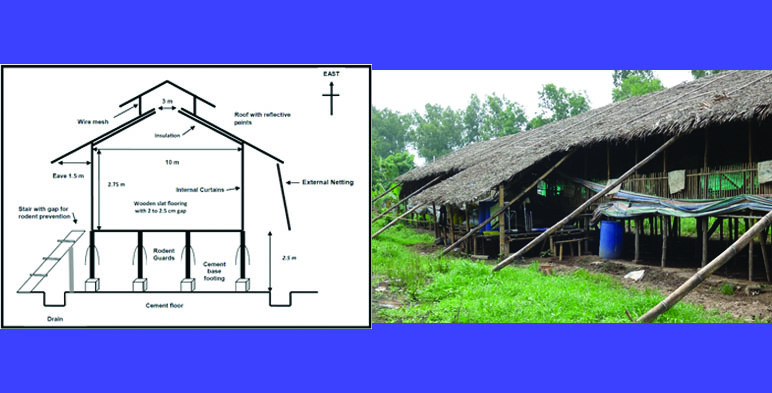
Temperature control starts with house design. Roofs should be double- or triple-ridge designs to allow hot air to escape rapidly, especially if they are uninsulated. The roof should extend 1.0-1.5 m beyond the house walls to prevent direct sunlight and rain from reaching the chickens, and shade cloth should run from the edge of the roof to the ground. A white or shiny roofing material will help reflect heat away from the building, and under-roof insulation can reduce radiant heat entering the house. Vegetation near a slat house can reduce ground temperature compared to bare earth, and trees can provide shade, but the benefits must be weighed against the risk of creating places for birds and rodents near the house.
Brooding in open houses can bring additional challenges. To preserve the warm air around the chicks, the brooding area will normally be enclosed with plastic curtains to form a tent. The tent sides can be partially opened during the day to remove gases, improve air exchange, and dry out the litter. Environmental conditions and bird behavior will determine the amount of opening. At night, some air exchange is necessary to prevent the buildup of gases, especially when using a brooder. If brooding on slats, cover the brooding area with cloth or netting, and spread litter on top to provide a warm floor for the chicks.
Curtain Management: The Main Control Tool
Ventilation management in open-sided houses requires constant adjustment. Daytime temperatures tend to be high, and birds can easily chill at night or during rain. Curtains keep warm air in the house, block direct sunlight, and keep rain out, but must be opened to allow air exchange, reduce humidity, and dry out any litter. The curtains should be able to be winched up or down. For the first 2 weeks, the aim is to keep the birds sufficiently warm while providing adequate ventilation. After day 2, the opening at the top can be increased to allow air to exchange. From day 14 onwards, the bottom of the curtain can be gradually opened to improve ventilation. The curtain opening should be adjusted to balance air quality, temperature, and chick comfort.
Stockmanship in open-sided houses is more critical than in other housing types because curtains must be adjusted throughout the day and night in response to changing environmental conditions and bird behavior. The farm team should check for bird distribution, normal feeding and drinking activity, dry litter, dust- and odor-free air, and proper equipment function, and make adjustments as necessary.
Circulation fans can increase air movement and, on hot days, provide a wind-chill effect in the house. These fans should either point along the house or diagonally across. Fogging or misting systems can be used with circulation fans to cool the house via evaporation, but they should be avoided when humidity exceeds 80%.
Stocking Density
Open-sided houses typically run at lower densities than closed houses. As the temperature increases, the stocking density should be reduced to allow broilers the space to dissipate body heat. Migration fences should be used to ensure even stocking density throughout the house. Open-sided houses are not recommended for birds grown to 3kg or more.
Feeding regimes
When environmental temperatures are high, birds will tend to reduce their feed intake. Try to avoid feeding birds during the hottest part of the day, and give the highest-quality pellets or crumbles available, as this will reduce the energy required to eat. Discuss opportunities with your feed provider to increase vitamins such as E, D, C, and B3, as well as adjust electrolytes, as these have been shown to improve the birds’ heat tolerance.
Fresh, clean water should be available at all times. Birds prefer cool water. Warm water will reduce water intake and, consequently, feed intake. Flushing lines, insulating pipes and tanks, avoiding black tanks in direct sunlight, and placing tanks and pipes underground can all help to reduce the water temperature in the house.
Biosecurity: Higher Risk in Open Systems
Open-sided houses are often exposed to biosecurity risks, so programs must be rigorous. Ensure that effective bird proofing is in place on all open parts of the house. Remove or cut back all vegetation within 3m of the house to discourage rodents and other animals. Bait heavily for rodents and regularly check for activity. Minimize the number of people entering the property, and provide them with a change of clothes and footwear before they enter the farm. Change footwear and sanitize hands between each house. Focus on cleaning and disinfecting the house and equipment between flocks, and try to maximize time between depletion and next placement.
In open-sided systems, success comes from attention, adjustment, and quick action because conditions change every day; the best farmers are the ones who respond the fastest.
For more information, visit www.aviagen.com or scan the QR code.